The Loop sits within LFA7, which covers the whole of Wales. A wide variety of UK and allied military aircraft have used it for low-level training — from current fast jets to historic types that are now long retired.
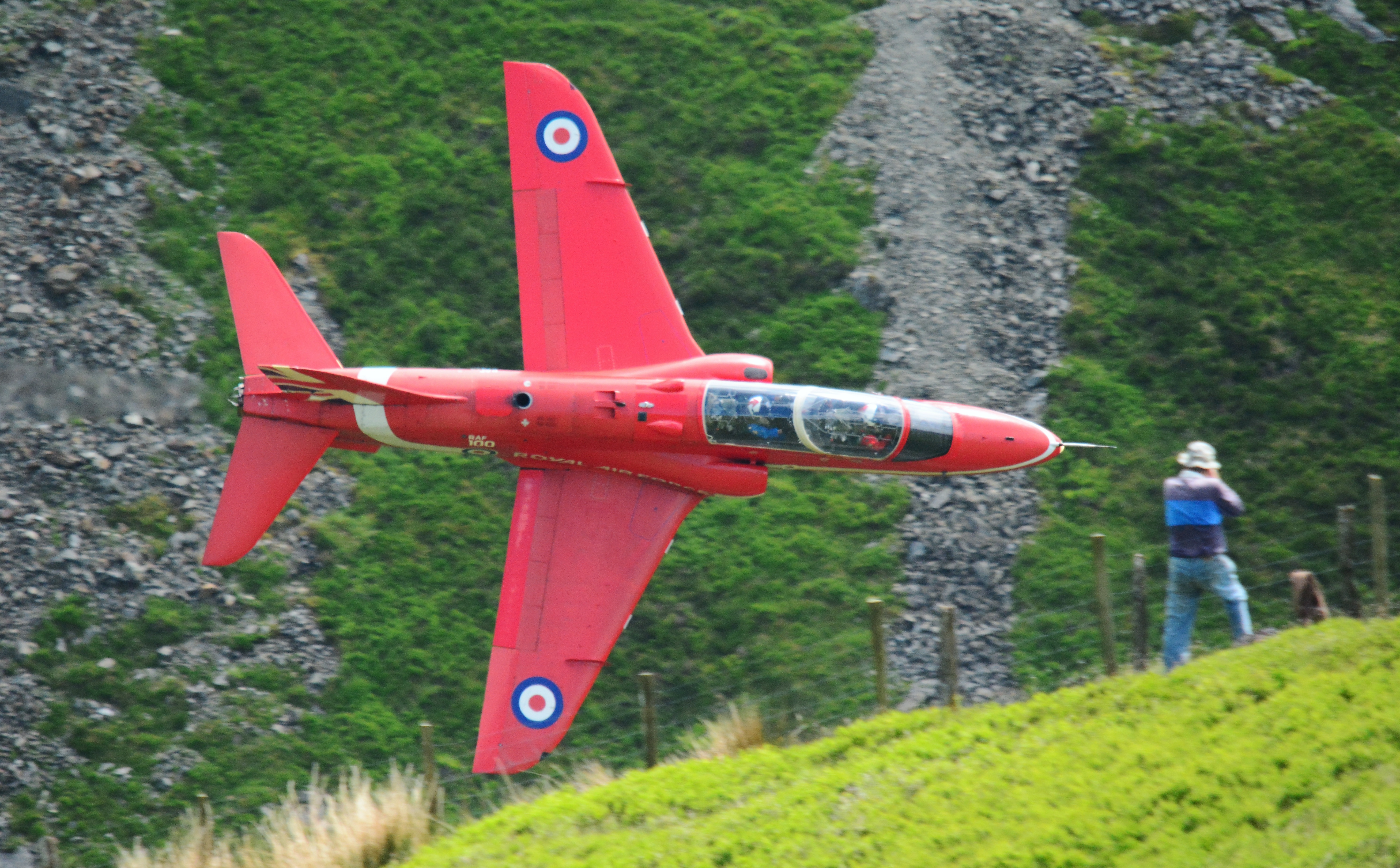
A RAF Red Arrows Hawk T1 photographed in the Mach Loop. Sightings are rare — treat one as the genuine bonus it is.
The Red Arrows and the Mach Loop
The RAF Red Arrows are not regular visitors to the Mach Loop — but they do appear, and when they do, it stops everyone on the hill in their tracks.
Unlike the training aircraft and fast jets that pass through LFA7 routinely, Red Arrows sightings in the Loop tend to fall into two distinct categories: transit routing to or from displays and flypasts across Wales and the wider UK, and deliberate low-level training undertaken as part of winter preparation or pre-season shake-down sorties. Either way, they are never scheduled and never guaranteed.
Twin-engine, delta-canard design. Extremely loud — you hear it well before you see it. Always a highlight on any day at the Loop.
The STOVL variant in RAF service. Increasingly sighted as the fleet grows into operational maturity. A purchase of 12 conventional F35-A was annunced.
The legendary jump jet. Vectored thrust gave the Harrier an utterly unique flight envelope and it used that capability to full effect in the Mach Loop — capable of speeds and low-level profiles that constantly surprised onlookers. The GR3, GR7, and GR9 variants all flew the Welsh valleys across four decades of RAF service before the premature 2010 retirement.
One of the most iconic Mach Loop aircraft of all time. Variable-sweep wing, ground-attack specialist. Flew the Loop for decades before its 2019 retirement. A generation of spotters grew up watching the Tornado here.
The air defence variant of the Tornado. Longer fuselage and fixed wings compared to the GR4. Used the Loop during training sorties before the Typhoon took over the intercept role.
A small, nimble ground-attack aircraft that was well suited to the low-level environment. A regular at the Mach Loop throughout the 1970s, 80s and 90s before the Tornado GR4 took over the role.
The thunderous twin-engined Cold War workhorse. Operated both the fighter and ground-attack roles. Smoke trails from its Rolls-Royce Spey engines made it unmistakeable in the valleys.
Built specifically for low-level, high-speed strike. The Buccaneer was arguably more at home in the Mach Loop than almost any other type — it was precisely the environment it was designed to exploit.
Based just over the hills on Anglesey. Frequently seen in formation pairs or groups. One of the most reliably spotted aircraft at the Loop.
Turboprop trainer flown before students progress to the Hawk stream. Often seen in small groups from RAF Valley, particularly in the mornings.
The original Hawk variant and the backbone of RAF advanced training for decades. Still flown by the Red Arrows but largely retired from Valley's training fleet in favour of the T2.
Turboprop basic trainer that prepared pilots for fast jet streams. A familiar sight in the Loop during its long service life before being succeeded by the Texan T1.
The jet trainer that preceded the Hawk. Flew the Welsh valleys throughout the 1960s, 70s and into the 80s as part of the advanced flying training curriculum before being replaced by the Tucano.
Occasionally operated through LFA7 by ETPS at Boscombe Down during test pilot training sorties. A rare but distinctive twin-engined light jet — Franco-German in origin and unmistakeable in profile.
Large turboprop transport that is surprisingly agile at low level. Slow and dramatic — brilliant for video. Its sheer size in the valley is striking. Now the RAF's primary tactical airlifter following the Hercules retirement.
The massive strategic transport has been seen in LFA7 during low-level training sorties — a genuinely extraordinary sight given its size. The RAF continues to operate the C-17 from Brize Norton.
After 56 years of RAF service, the Hercules made its final flight in June 2023 with tactical airlift passing to the A400M Atlas. Both the J model and earlier K variant were regular low-level users of LFA7 throughout their service lives — a much-missed sound in the Welsh valleys.
360 Radar and ADS-B Exchange can help spot military aircraft transiting toward Wales in real time. See the Live Aircraft Tracking guide and Airband Scanners guide →
The Fleet Air Arm returned to fast jet operations with the F-35B. 809 Naval Air Squadron operates the type and uses LFA7 for low-level currency alongside their RAF counterparts from RAF MArham.
The large three-engined helicopter used in both the anti-submarine and commando assault roles. A regular in LFA7 for low-level navigation and crew training in the Welsh terrain.
Successor to the Lynx in Fleet Air Arm service. Has been seen in Welsh low-level areas during operational training, though sightings at the Mach Loop corridor specifically remain uncommon.
The iconic search and rescue and anti-submarine helicopter. Based at RAF Valley for many years in the SAR role — a familiar sight over Wales for decades before the contract transferred to Bristow in 2015.
The agile shipborne helicopter that served the Royal Navy for over four decades. Used Welsh low-flying areas during operational training sorties throughout its service life.
FRADU operated Hawks in a distinctive overall yellow scheme for fleet target facilities and air direction training. Occasionally used LFA7 during tasking over Wales — easy to spot in the valleys thanks to the striking colour scheme.
The AAC's primary attack helicopter. Uses the Welsh mountains extensively for nap-of-the-earth and terrain-masking training. Can appear at very low level through the valleys — a dramatic and often unexpected sight.
The heavy-lift tandem-rotor helicopter is a frequent visitor to LFA7. Its distinctive twin-rotor profile and low rumble make it easy to identify well before it appears. Often seen in the valley systems on crew training exercises.
The medium utility helicopter that has served the RAF since the 1970s. Upgraded to HC2 standard and still operating, the Puma regularly uses LFA7 for crew training in challenging mountain terrain.
Successor to the Lynx in AAC service. The Wildcat has been seen in LFA7 during operational training, though sightings specifically at the Mach Loop valley corridor remain relatively uncommon.
The Army's agile battlefield helicopter for four decades. Used the Welsh low-flying system throughout its service life for crew conversion and mission training before being replaced by the Wildcat and Apache.
Not military aircraft, but worth noting. The Wales Air Ambulance operates throughout Snowdonia and mid-Wales. If you see a yellow or red helicopter low in the valleys, do not confuse it with military traffic — it may be responding to a real emergency.
F-15 at the Mach Loop
The F-15E Strike Eagle from USAF Lakenheath is one of the most anticipated aircraft at the Mach Loop. Based just 130 miles away in Suffolk, the 48th Fighter Wing regularly uses LFA7 for low-level training — and the sight and sound of an F-15E at 250 feet and 400+ knots through a Welsh valley is unlike anything else. USAF aircraft do not fly on US federal holidays. See live tracking tools for spotting inbound F-15s from Lakenheath.
Generates enormous excitement whenever it appears. The twin-engine Strike Eagle at low level in the Loop is one of the defining Mach Loop experiences. Won't fly on US federal holidays.
Now regularly sighted as the type settles into full operational use at Lakenheath. The F-35A replaced the F-15C Eagle in the air superiority role and is increasingly seen in LFA7.
The pure air superiority variant of the Eagle. Based at Lakenheath for decades and a long-standing Mach Loop regular before being replaced by the F-35A in 2021. Powerful, angular, and extremely loud — a classic Loop subject.
Before the Strike Eagle arrived at Lakenheath, the F-111 was the USAF's primary low-level strike aircraft in Europe — and the Mach Loop was part of its training environment. Variable-sweep wings, terrain-following radar, and an ability to operate at very high speed and very low altitude made it perfectly matched to LFA7. A thunderous and deeply missed presence in the Welsh valleys.
Seen historically during temporary deployments to UK bases. The lightweight single-engine fighter is well suited to low-level work and has appeared in LFA7 during exercises.
The famed tank-buster. A genuinely rare Mach Loop sighting but one that causes considerable excitement when it happens. The A-10's straight wing, twin-tail, and distinctive turbofan nacelles are unmistakeable at low level.
One of the rarest sightings possible in LFA7. The F-22 has visited the UK on several occasions and has been recorded in the Welsh low-flying system. An extraordinary capture for anyone fortunate enough to be there.
The tilt-rotor Osprey is immediately recognisable and always a memorable sight. Its ability to transition between helicopter and fixed-wing flight makes it well suited to the terrain-hugging profiles used in LFA7.
Large, low, and very loud. The special operations variant of the Hercules. Uses the Welsh low-flying system for crew training in terrain avoidance and low-level insertion profiles.
The massive strategic transport has been seen in LFA7 during low-level training sorties — a genuinely extraordinary sight given its size. USAF C-17s visit the UK regularly on exercises and logistics missions.
Canadian Hornets have appeared in LFA7 during NATO exercises and bilateral training visits to UK bases. The CF-18 is externally similar to the USN F/A-18 but carries distinctive Canadian markings.
US Navy and Marine Corps Hornets have been seen in the Welsh low-flying system during detachments to UK bases. Both the legacy Hornet and the larger Super Hornet have been recorded.
The French delta-canard multirole fighter has appeared in LFA7 during joint NATO exercises. An exotic and striking aircraft at any altitude — at low level in the Welsh valleys it is something else entirely.
The lightweight Swedish multirole fighter has been sighted in LFA7 during bilateral training exercises. Its small size makes it particularly agile at low level — and surprisingly difficult to spot until it is almost on top of you.
The NATO medium utility helicopter has appeared in Welsh airspace during multinational exercises. Operated by numerous European nations, markings and colour schemes vary considerably between operators.
The aircraft of Canada's Snowbirds display team. An exceptionally rare sighting in LFA7 — recorded during transit flights associated with display appearances in the UK. About as unlikely a Mach Loop visitor as it is possible to imagine.